GEOTECHNICALENGINEERING1
ADELAIDE
HomeInvestigationCPT (Cone Penetration Test)

Cone Penetration Testing (CPT) in Adelaide: High-Resolution Subsurface Profiling

Site investigations you can build on.

LEARN MORE

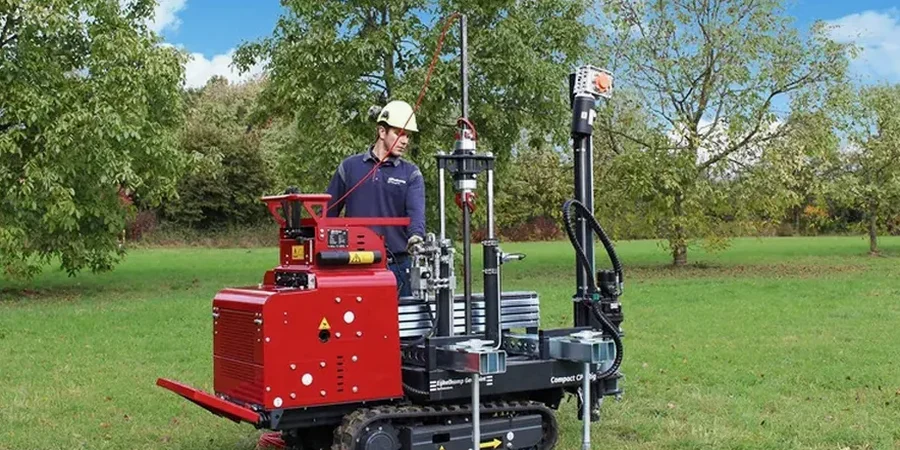
A twelve-story mixed-use development on Grenfell Street encountered an unexpected 2.8-metre layer of dense calcrete just below the fill line. Traditional rotary drilling struggled to define the interface, but a 20-tonne CPT rig pushed through, logging continuous tip resistance and sleeve friction every 20 millimetres. Adelaide’s subsurface is a patchwork of Hindmarsh Clay, Torrens alluvium, and weathered phyllite; each stratum demands a different interpretation approach. The cone penetration test delivers exactly that, capturing pore pressure dissipation curves that reveal consolidation behavior, and friction ratios that distinguish the stiff Pleistocene clays from the softer Holocene silts. For projects near the River Torrens or across the Adelaide Plains, this high-resolution profiling is the benchmark for settlement prediction and pile design. When the site geology suggests variability, we pair the CPT dataset with targeted test pits to visually calibrate the stratigraphy and validate the cone sleeve readings against known material behavior.

A single CPT sounding in Adelaide’s alluvial corridor provides more stratigraphic detail than six SPT boreholes—and it does so without disturbing the sample.
Our service areas

How we work

The CPT rig used across Adelaide sites is a truck-mounted unit with a 200 kN hydraulic push system, capable of penetrating to 30 metres in the uncemented sediments of the basin. A 15 cm² standard electronic cone, fitted with a 60-degree apex tip and a porous filter element, records three channels simultaneously: corrected cone resistance (qt), sleeve friction (fs), and dynamic pore pressure (u2). In the Keswick area, where the Quaternary sediments exceed 45 metres in depth, the system resolves layers as thin as 15 millimetres—something no SPT split spoon can achieve. Data streams at 25 Hz are transmitted through a wireless link to a mobile logging unit, where the soil behavior type index (Ic) is computed in real time following Robertson’s 1990 classification chart, updated for Adelaide’s carbonate-rich profiles. The resulting continuous log is essential for calibrating seismic refraction velocity models and establishing site class to AS 1170.4-2007, particularly on the steeply sloping blocks of the Mount Lofty Ranges foothills.
Cone Penetration Testing (CPT) in Adelaide: High-Resolution Subsurface Profiling
Technical reference — Adelaide

Local geotechnical context

Soil conditions along the Para Fault zone differ markedly from the flat-lying Keswick Clay basin. In the east, around Rostrevor, shallow refusal on siltstone bedrock can occur at 3 metres; in the west, near West Lakes, soft estuarine clays extend beyond 25 metres with undrained shear strengths below 15 kPa. A CPT profile that stops short of the dense layer because of insufficient push capacity leaves the foundation engineer with a dangerous gap, risking differential settlement where the bedrock steps abruptly. Pore pressure dissipation tests run in these soft clays—monitoring the decay of u2 over 30 to 60 minutes—provide the coefficient of consolidation (cv) that directly feeds into the settlement-time calculations for raft foundations. In the Adelaide CBD, where excavation-induced drawdown affects neighboring heritage structures, the CPT’s ability to detect artesian pressures in the upper Quaternary sands becomes a safety-critical measurement. The deep excavations team relies on this pore pressure profile to design dewatering systems that maintain hydraulic stability in the carbonate-rich aquifer.

Need a geotechnical assessment?

Reply within 24h.

Email: contact@geotechnicalengineering1.co

Relevant standards

AS 1726:2017 - Geotechnical site investigations, AS 1289.6.5.1-1999 - Soil strength and consolidation tests; determination of the static cone penetration resistance of a soil, AS 1170.4-2007 - Structural design actions, Part 4: Earthquake actions in Australia, Robertson & Cabal (2015) CPT guide classification system

Typical values

ParameterTypical value
Cone type15 cm² area, 60° apex, friction sleeve 150 cm²
Maximum push force200 kN (standard rig); 250 kN available for deep calcrete
Penetration rate20 mm/s ± 5 mm/s per AS 1726 requirements
Measured parametersqt (corrected cone resistance), fs (sleeve friction), u2 (pore pressure)
Derived parametersRf (friction ratio), Ic (SBT index), OCR, su, relative density (Dr)
Data acquisition rate25 Hz continuous, wireless transmission to logging unit
Seismic module (SCPT)Triaxial geophone array, Vs at 1-metre intervals

Quick answers

What depth can a CPT rig achieve in Adelaide's subsurface conditions?

In the uncemented Quaternary sediments of the Adelaide Plains, a standard 200 kN CPT rig typically reaches 25 to 30 metres. In the foothills east of the city, where weathered phyllite and siltstone bedrock is shallow, refusal may occur at 3 to 6 metres. A preliminary SPT drilling program helps predict the expected refusal depth before mobilizing the CPT truck.

How does pore pressure dissipation testing (PPDT) improve settlement predictions?

During a dissipation test, the cone is held at a target depth while the decay of excess pore pressure (u2) is recorded. The time to 50% consolidation (t50) yields the coefficient of consolidation (cv) in the horizontal direction. For the compressible Keswick Clay and Hindmarsh Clay formations, this cv value is directly input into finite element consolidation models to calculate the rate and magnitude of settlement under a proposed raft or piled foundation.

What is the typical cost range for a CPT investigation in Adelaide?

A single CPT sounding in Adelaide, including mobilization within the metropolitan area, pore pressure dissipation at one depth, and a factual data report to AS 1726, generally falls between AU$270 and AU$440 per metre of penetration depth. The total project cost depends on the number of soundings, traffic control requirements, and whether seismic (SCPT) modules are included.

Can CPT data be used for liquefaction assessment in Adelaide?

Yes. The corrected cone resistance (qc1N) and friction ratio from CPT soundings are applied in the NCEER/Youd-Idriss (2001) procedure to calculate the factor of safety against liquefaction triggering. This is particularly relevant for sites along the River Torrens paleochannel, where loose saturated sands exist below the water table and the seismic hazard from the Para and Eden-Burnside fault zones must be considered per AS 1170.4.

Location and service area

We serve projects in Adelaide and surrounding areas.

View larger map