GEOTECHNICALENGINEERING1
ADELAIDE
HomeRoadwayFlexible pavement design

Flexible Pavement Design for Adelaide’s Reactive Soils

Site investigations you can build on.

LEARN MORE

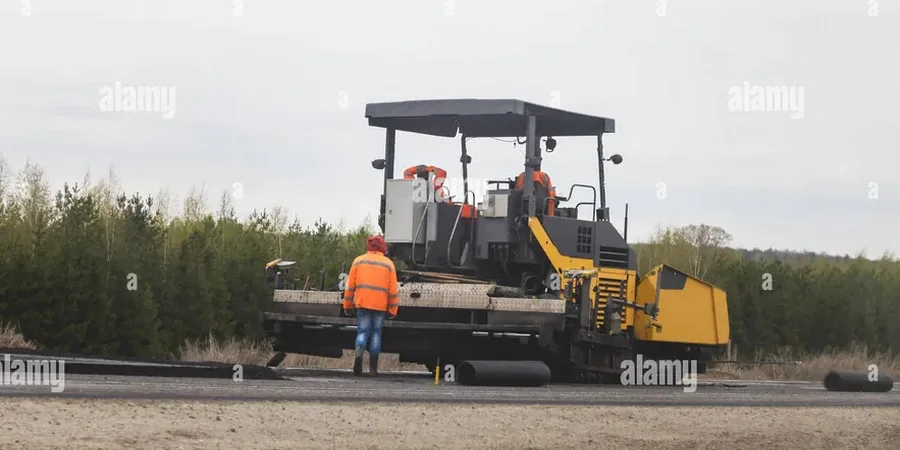
Adelaide sits on a thin coastal plain wedged between the Gulf St Vincent and the Mount Lofty Ranges. That geography traps heat. Summer pavement temperatures here routinely exceed 60°C at the surface, while the underlying clay subgrades shrink and heave with seasonal moisture changes. A standard pavement section imported from Melbourne or Sydney fails quickly under these local stresses. Flexible pavement design in Adelaide must account for both high-temperature rutting resistance and the volumetric instability of reactive clay foundations. The subgrade CBR can swing from 8% in winter to below 2% in a dry February. Getting the asphalt modulus, granular layer thickness, and subgrade treatment right is what separates a 20-year pavement from one that cracks before the first defect liability inspection. We combine the CBR road testing protocol with site-specific moisture conditioning to anchor the design in real local conditions, not textbook defaults.

In Adelaide, a flexible pavement lives or dies by what happens 300 mm below the asphalt surface — get the subgrade right and the pavement outlasts the design life.
Our service areas

How we work

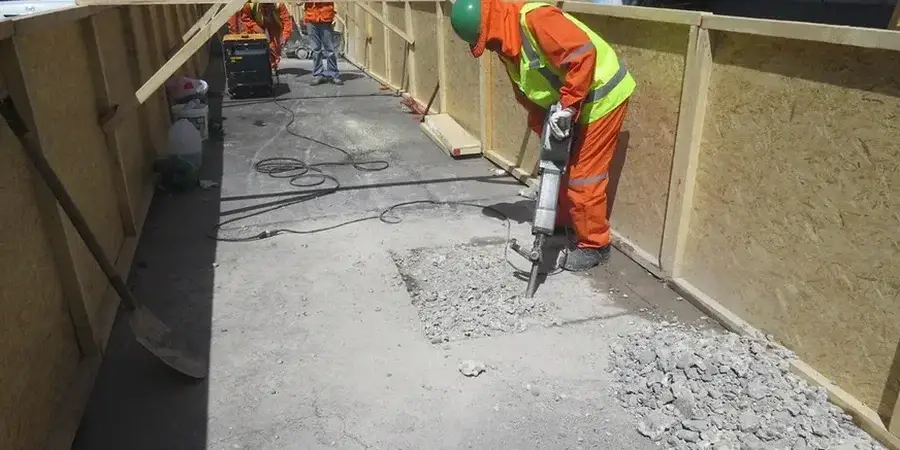
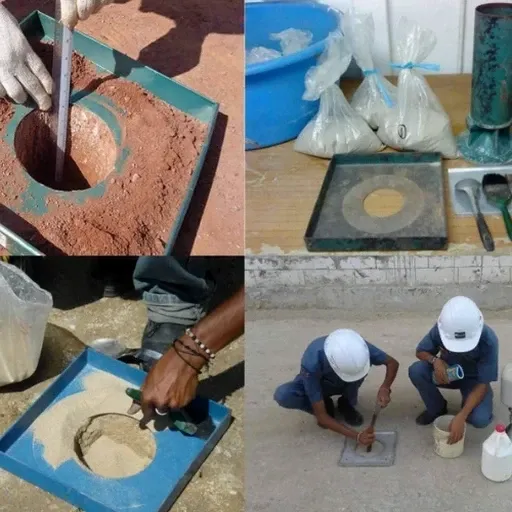
A practical observation from years of pavement investigations across the Adelaide metropolitan area: the worst failures almost always trace back to inadequate subgrade preparation, not the asphalt itself. On the heavy black earths of the northern suburbs or the siltstone-derived clays of the foothills, even a 40-mm deformation in the subgrade propagates straight through to surface cracking. Our flexible pavement design methodology starts with a forensic-level subgrade evaluation. We run soaked CBRs at multiple depths, Atterberg limits to quantify shrink-swell potential, and suction measurements during the driest month. The pavement layers are then modelled using the Austroads mechanistic-empirical framework. Asphalt mix design targets a binder grade that resists rutting under Adelaide’s peak summer temperatures. For heavily trafficked industrial pavements, we often specify a high-modulus asphalt base layer over a cement-stabilized subbase. The Proctor tests data feeds directly into the compaction specification, ensuring the contractor hits density targets that hold up through the first wet-dry cycle. Every design package includes a drainage layer assessment. Ponded water at the subbase-subgrade interface is a silent pavement killer in Adelaide’s winter-spring transition.
Flexible Pavement Design for Adelaide’s Reactive Soils
Technical reference — Adelaide

Local geotechnical context

The most expensive mistake we see in Adelaide pavement projects is value-engineering the subgrade investigation to save a few thousand dollars. A developer orders a design based on two CBR tests taken in July when the soil is moist, then construction starts in January. The clay has dried to a brick-hard consistency. The contractor assumes excellent support, reduces the granular layer, and lays asphalt. First winter rains arrive, the clay swells, differential heave cracks the pavement, and the owner faces a $250,000 reconstruction within 18 months. Another recurring failure: specifying a standard bitumen binder without checking the pavement temperature regime. Adelaide’s prolonged heatwaves push the surface temperature past the binder softening point, and the asphalt ruts under channelized traffic. A proper flexible pavement design eliminates these risks by conditioning subgrade samples at both wet and dry extremes, and selecting binder performance grades matched to local climate data, not generic regional tables.

Need a geotechnical assessment?

Reply within 24h.

Email: contact@geotechnicalengineering1.co

Relevant standards

Austroads AGPT02 Guide to Pavement Technology Part 2: Structural Design, AS 1289 Methods of testing soils for engineering purposes, AS 2150 Hot mix asphalt, AS 3798 Guidelines on earthworks for commercial and residential developments

Typical values

ParameterTypical value
Design traffic (ESA)Up to 10⁷ equivalent standard axles
Asphalt modulus at 60°C2,500–4,500 MPa
Subgrade CBR threshold (soaked)≥5% for light traffic, ≥10% for heavy
Granular layer thickness150–300 mm per Austroads AGPT02
Binder gradeA10E to A35P depending on traffic
Stabilization depth200–350 mm cement or lime-treated
Design period20–40 years per Austroads
Deflection criterion<0.5 mm for heavy-duty pavements

Quick answers

How much does a flexible pavement design cost in Adelaide?

For a typical residential subdivision or small commercial pavement in Adelaide, the design fee ranges from AU$2,860 to AU$8,170 depending on traffic loading, subgrade variability, and whether the scope includes construction-phase verification. High-volume industrial pavements with full mechanistic modelling and multiple design iterations sit at the upper end. The cost includes subgrade investigation, soaked CBR laboratory testing, Austroads-compliant structural design, and a stamped engineering report suitable for council or DIT approval.

Why is subgrade preparation more critical in Adelaide than in other Australian cities?

Adelaide has extensive areas of reactive clay soils that undergo significant volume change with moisture fluctuation. The city’s Mediterranean climate — with hot, dry summers and cool, wet winters — creates extreme seasonal moisture cycles. A subgrade that provides good support in August can lose 70% of its bearing capacity by February. Without proper moisture conditioning and stabilization, this movement directly cracks the pavement. Our design protocol specifically tests subgrade response at both saturation extremes to account for this Adelaide-specific behaviour.

What Austroads traffic category does a standard Adelaide residential street require?

Most residential streets in Adelaide fall under Austroads Category 3 or 4, corresponding to 10⁵ to 10⁶ equivalent standard axles over the design life. Collector roads and bus routes typically move up to Category 5 or 6. The exact category depends on the development density and proximity to arterial roads. We determine the category during the design brief phase and adjust the pavement section accordingly.

Location and service area

We serve projects in Adelaide and surrounding areas.

View larger map