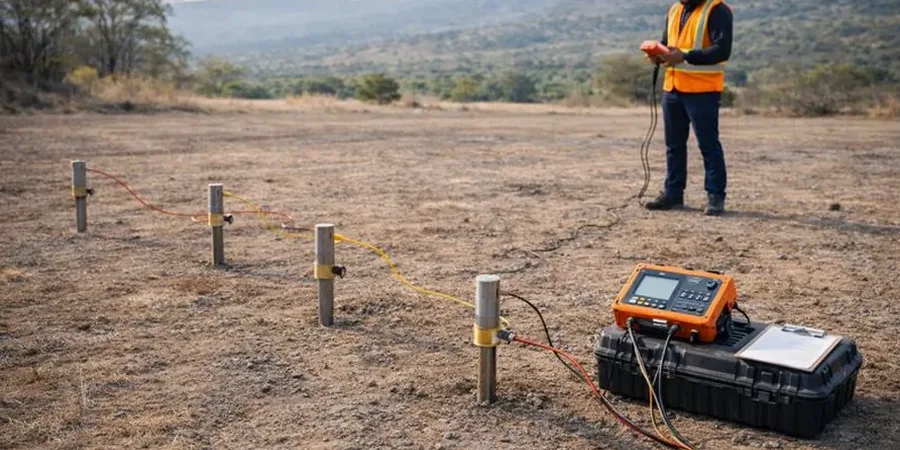
Adelaide's subsurface tells two very different stories. The western suburbs sit on Quaternary alluvium and estuarine clays, while the eastern foothills rise into fractured Proterozoic basement rock of the Mount Lofty Ranges. This sharp geological contrast creates a practical problem for site investigation: drilling alone often misses what lies between boreholes. Electrical resistivity testing (VES) fills that gap. It maps vertical changes in apparent resistivity, distinguishing saturated clay from dry sand, or weathered rock from competent stone. In a city where saline groundwater intrudes up to 5 km inland from Gulf St Vincent, resistivity becomes more than a profiling tool. It becomes a necessity. The method works by injecting a known current through stainless steel electrodes and measuring the resulting potential difference, building a 1D sounding curve that geophysicists invert to true resistivity versus depth. When combined with CPT soundings to calibrate the resistivity-to-soil-type correlation, the result is a continuous stratigraphic model that no number of boreholes alone could produce.
A VES sounding curve can tell you where saline water ends and fresh rock begins, without ever breaking ground.