GEOTECHNICALENGINEERING1
ADELAIDE
HomeSeismicBase isolation seismic design

Base Isolation Seismic Design in Adelaide: A Practical Engineering View

Site investigations you can build on.

LEARN MORE

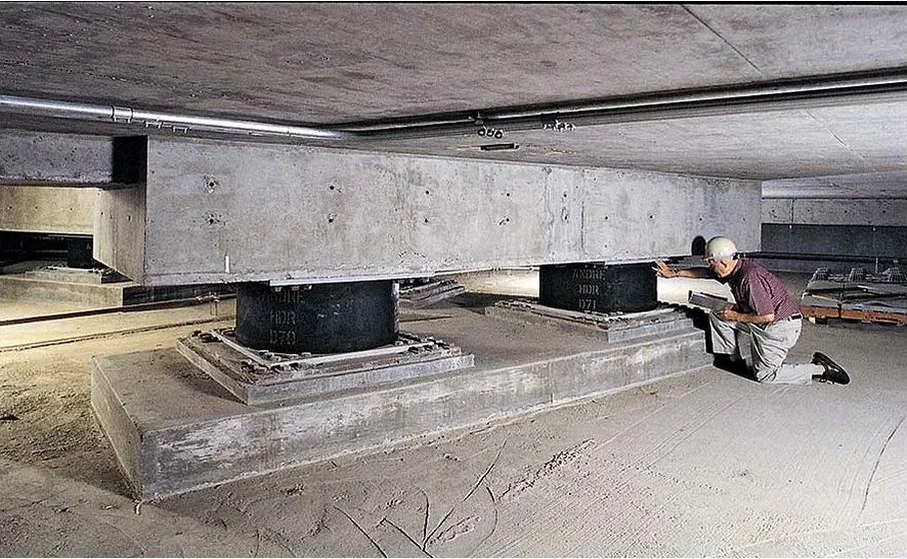
The most persistent mistake we see in Adelaide is treating base isolation as a simple product selection rather than a site-specific seismic design exercise. Teams order generic isolators from a catalogue, bolt them under the structure, and assume the building will ride out an earthquake. That approach ignores the stiff Pleistocene clays and the variable depth to bedrock across the Adelaide Plains. The city sits on a thin sediment veneer over Proterozoic basement, with the Para Fault and Eden-Burnside Fault still active enough to generate magnitude 5 to 6 events roughly every few thousand years. A proper base isolation seismic design here must reconcile the short-period spectral demand with the long-period displacement capacity of the isolators, all while accounting for the shrink-swell behaviour that defines Adelaide’s reactive soil profile. When the isolator period is tuned without factoring in the site-specific response spectrum from AS 1170.4, the structure may amplify ground motion rather than filter it. We often pair early-stage seismic microzonation with seismic microzonation studies to map the basin-edge effects that complicate isolation design in the eastern suburbs.

In Adelaide, the design displacement of an isolation system is governed less by the design earthquake magnitude and more by the stiffness contrast between the shallow reactive clays and the basement rock beneath.
Our service areas

How we work

A nine-storey mixed-use building near the corner of Pulteney Street and Flinders Street taught us a lesson we still apply to every Adelaide isolation project. The geotechnical investigation revealed highly plastic Keswick Clay at 3 metres depth, with groundwater perched at 2.5 metres after winter rains. The structural team initially specified lead-rubber bearings with a target period of 2.8 seconds, assuming firm ground conditions. Our review of the site-specific response spectrum showed that the deep soil column—weathered siltstone transitioning to fresh Proterozoic basement at 28 metres—produced a spectral peak at 0.15 seconds that did not align with the isolator period. We revised the design to include triple-friction pendulum isolators with a longer effective period and added a moat wall detail that allowed 450 millimetres of lateral displacement without sacrificing the waterproofing integrity required for the basement car park. The slope stability analysis for the adjacent excavation—a 6-metre cut into the eastern boundary—confirmed that the temporary shoring would not compromise the isolation plane during construction. A base isolation seismic design in Adelaide rarely fails because of the isolator hardware; it fails because the soil-structure interaction and the displacement compatibility across the isolation interface were not modelled to the level the site demands.
Base Isolation Seismic Design in Adelaide: A Practical Engineering View
Technical reference — Adelaide

Local geotechnical context

Adelaide’s recorded seismic history includes the 1954 magnitude 5.6 earthquake centred near Darlington, which cracked masonry across the inner suburbs and generated peak ground accelerations estimated at 0.07g. While that figure seems modest, the recurrence of a similar event on the Para Fault today would produce significantly higher spectral accelerations in the short-period range due to the stiff soil amplification observed in recent microtremor surveys. A fixed-base building on a Class C or Class D site in the CBD could experience inter-storey drifts that exceed the 1.5 percent limit in AS 1170.4, particularly if the lateral system relies on shear walls without redundancy. Base isolation seismic design mitigates this by shifting the fundamental period well beyond the amplified spectral range, but the cost of getting the isolation plane wrong—either through inadequate displacement capacity or insufficient protection against groundwater ingress at the moat—is a building that underperforms its fixed-base counterpart. The 2017 amendment to AS 1170.4 introduced stricter requirements for near-fault effects, and structures within 5 kilometres of the mapped fault traces in the eastern foothills must now consider forward-directivity pulses in the displacement time-history analysis.

Need a geotechnical assessment?

Reply within 24h.

Email: contact@geotechnicalengineering1.co

Relevant standards

AS 1170.4:2007 (Amdt 2, 2018) – Structural design actions: Earthquake actions in Australia, AS 1726:2017 – Geotechnical site investigations, AS 3600:2018 – Concrete structures (for isolation plinths and moat walls), AS 4100:2020 – Steel structures (for isolator connection plates), AS 5100.2:2017 – Bridge design: Design loads (for isolated bridge structures)

Typical values

ParameterTypical value
Design standard for seismic actionsAS 1170.4:2007 (Amdt 2, 2018)
Site sub-soil class range (Adelaide Plains)Class C (shallow rock) to Class D (deep soil)
Isolator types commonly specifiedLead-rubber bearings (LRB), triple-friction pendulum (TFP), high-damping rubber (HDRB)
Target effective period (Teff)2.5 to 4.0 seconds depending on site class
Design displacement demand (DBE level)250 to 500 mm typical for Adelaide basin sites
Minimum moat clearance1.2 x Dmax per AS 1170.4 Section 11
Vertical load capacity per isolator1,500 kN to 12,000 kN (project-specific)
Relevant structural standardAS 3600:2018 for concrete, AS 4100:2020 for steel

Quick answers

Is base isolation mandatory for buildings in Adelaide, or can a fixed-base design still comply with AS 1170.4?

Base isolation is not mandatory under the National Construction Code or AS 1170.4 for any building category in Adelaide. A fixed-base design can comply provided it meets the drift limits, detailing requirements, and capacity design provisions in Section 5 of the standard. However, for Importance Level 3 and 4 structures—hospitals, emergency response centres, large schools—the post-earthquake functionality requirement often makes isolation the more economical path once you factor in the cost of repairing structural and non-structural damage in a fixed-base scheme. The decision should follow a comparative life-cycle analysis, not a prescriptive rule.

How much does a base isolation seismic design for an Adelaide mid-rise building typically cost?

For a complete design package—including site-specific response spectrum, isolator specification, peer review of manufacturer submittals, and displacement compatibility detailing—the fee typically falls between AU$5,650 and AU$11,430 for a mid-rise commercial or residential structure of 4 to 10 storeys. The range depends on the number of isolator types, the complexity of the moat geometry, and whether non-linear time-history analysis on multiple ground motion suites is required. This covers the design engineering only; isolator procurement, testing, and installation are separate contractor-scope items.

What ground conditions in Adelaide cause the most trouble for base-isolated structures?

The combination of highly reactive Keswick Clay near the surface and steeply dipping basement rock at depths that vary from 5 metres in the foothills to over 40 metres near the Torrens River produces a pronounced impedance contrast. This generates a site amplification peak that can shift the spectral demand into the isolator’s effective period range if not properly modelled. Additionally, perched groundwater in the Quaternary sediments complicates moat construction and long-term waterproofing, especially on sites with basement levels. We always recommend at least one deep borehole to basement rock and a down-hole shear-wave velocity survey before finalising the isolation parameters.

Location and service area

We serve projects in Adelaide and surrounding areas.

View larger map