GEOTECHNICALENGINEERING1
ADELAIDE
HomeIn-Situ TestingField permeability test (Lefranc/Lugeon)

Field Permeability Testing (Lefranc/Lugeon) Across Adelaide's Geological Formations

Site investigations you can build on.

LEARN MORE

In Adelaide, we frequently encounter a stark contrast between the stiff, fractured clays of the foothills and the alluvial soils of the plains. A simple borehole log rarely tells the full story when groundwater is a factor. The in-situ permeability test, particularly the Lugeon test for rock mass and the Lefranc test for soils, becomes the deciding factor in dewatering design. We have seen projects near the River Torrens where assumed permeability based on grain size alone was off by an order of magnitude. That is why we rely on direct field measurements to quantify how water actually moves through the formation, whether it is the fractured Adelaide Geosyncline bedrock or the Quaternary sediments. Complementing this with a CPT test often helps us identify the thin, high-permeability lenses that control the overall hydraulic regime.

A Lefranc or Lugeon test measures the formation's willingness to transmit water at a specific depth, data that no grain-size correlation can reliably predict in Adelaide's mixed geology.
Our service areas

How we work

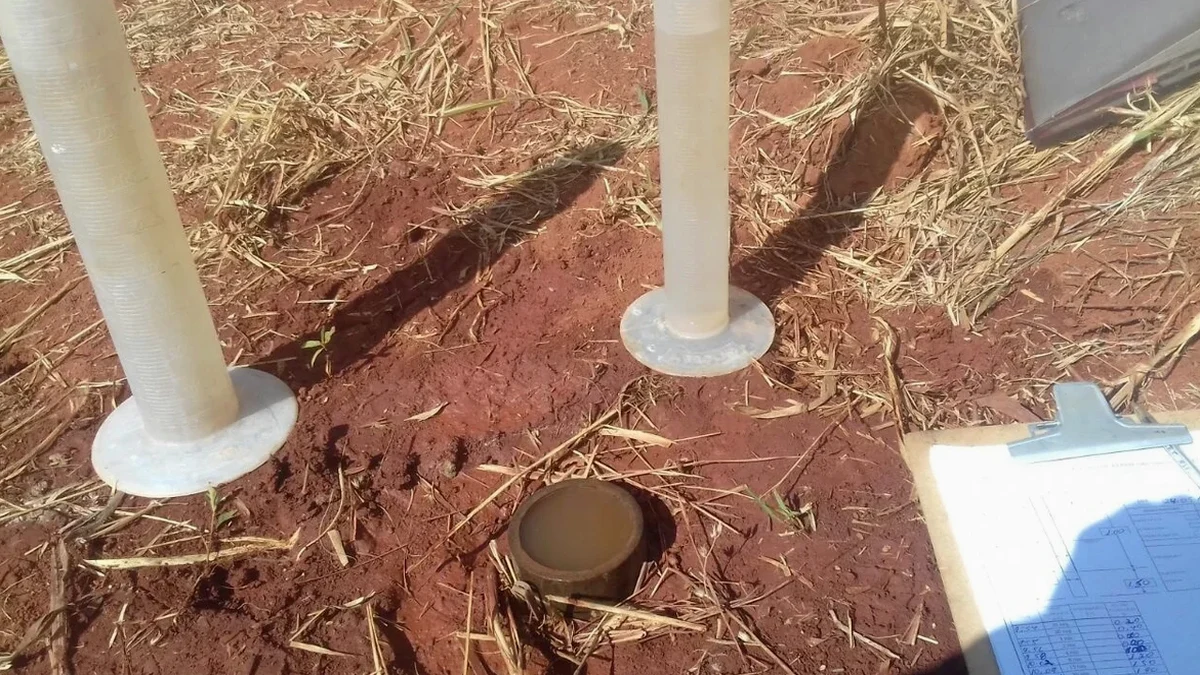
The equipment we mobilize across Adelaide is configured to handle both the tight access of inner-city sites and the remote conditions of the Mount Lofty Ranges. For a standard Lefranc test, we use a slotted, flush-jointed PVC screen isolated by a pneumatic packer, lowered to the test interval in a cased borehole. The constant-head or falling-head procedure follows AS 1726 guidelines, with a Mariotte bottle system maintaining a steady hydraulic gradient in permeable materials. For rock mass in the fractured quartzite and siltstone typical of the Adelaide Supergroup, the Lugeon apparatus operates at stepped pressures, typically five cycles to assess fracture dilation and infill washout. We power the pumps with electric motors where noise restrictions apply in suburbs like Unley, switching to diesel for undeveloped blocks. The data logger records pressure transients every second, ensuring we capture the full pressure-decay curve rather than just a single-point estimate, a practice that reveals non-Darcian flow behaviour in highly fractured intervals.
Field Permeability Testing (Lefranc/Lugeon) Across Adelaide's Geological Formations
Technical reference — Adelaide

Local geotechnical context

A multi-storey excavation on Grenfell Street hit a confined sand lens at 12 metres depth that had not been identified by standard SPT sampling. The initial inflow overwhelmed the sump pumps because the pre-construction hydrogeological model had used textbook permeability values for the Hindmarsh Clay. We deployed a series of Lefranc tests at close vertical spacing and found a 0.4-metre-thick layer with a hydraulic conductivity two orders of magnitude higher than the surrounding material. The contractor had to redesign the well-point system overnight, adding deep wells at 3-metre centres. This is a common scenario in Adelaide, where the Pleistocene alluvium contains discontinuous paleochannels filled with coarse sand and gravel. Overlooking a single high-permeability stringer can turn a routine basement dig into a protracted dewatering operation with significant cost overruns.

Need a geotechnical assessment?

Reply within 24h.

Email: contact@geotechnicalengineering1.co

Relevant standards

AS 1726-2017: Geotechnical site investigations, AS 4678-2002: Earth-retaining structures (for dewatering implications), Houlsby, A.C. (1976): Routine interpretation of the Lugeon water-test, USBR Design of Small Dams (for Lefranc test configuration)

Typical values

ParameterTypical value
Test methods employedLefranc (constant/falling head), Lugeon (packer test in rock)
Applicable standardAS 1726 (Geotechnical site investigations), USBR Earth Manual
Pressure increments (Lugeon)0, 1, 2, 5, 10 bar; stepped cycle per Houlsby interpretation
Borehole diameter rangeNX (76 mm) to PQ (122 mm), depending on target depth
Test interval lengthStandard 1.0 m isolated zone; custom 0.5 m in highly fractured rock
Data acquisition1-second interval logging of pressure and flow rate
Typical test depth5 m to 80 m below ground level, deeper for mining studies

Quick answers

What is the difference between a Lefranc test and a Lugeon test?

The Lefranc test measures hydraulic conductivity in unconsolidated soils using a screened section in a borehole, typically with a constant or falling head. The Lugeon test is specifically for fractured rock, where water is injected under stepped pressure increments to assess the rock mass permeability and the behaviour of fractures under pressure. We select the method based on whether the test interval is in the Quaternary sediments of the Adelaide Plains or the bedrock of the Adelaide Geosyncline.

Which Australian standard governs field permeability testing?

AS 1726-2017 provides the framework for geotechnical site investigations and covers the execution of in-situ permeability tests. For Lugeon tests, we also reference the Houlsby (1976) interpretation method and the relevant sections of the USBR Earth Manual, which are widely accepted in Australian practice for dam and tunnel works.

How long does a single Lefranc or Lugeon test take on site?

A single Lefranc test in soil typically requires between 60 and 90 minutes, including the time for borehole preparation, screen placement, and the test itself. A full five-cycle Lugeon test in rock can take two to three hours, depending on the depth, the permeability of the zone, and the time needed for pressure and flow to stabilize at each step.

What is the typical cost for a field permeability testing program in Adelaide?

For a single Lefranc or Lugeon test, including mobilization within the Adelaide metro area, borehole preparation, and reporting, the cost ranges from AU$1110 to AU$1.510 per test. A program of multiple tests at different depths reduces the per-test cost due to shared mobilization and setup time.

Can permeability tests be combined with other site investigation methods?

Absolutely. We often run permeability tests in the same boreholes used for SPT sampling or core logging, which provides a complete geotechnical and hydrogeological profile. This is particularly useful in Adelaide's complex alluvial sequences, where we need to correlate permeability with the grain-size distribution and plasticity of the soils encountered.

Location and service area

We serve projects in Adelaide and surrounding areas.

View larger map