In-situ testing forms the bedrock of reliable geotechnical engineering across Adelaide, providing direct measurement of soil and rock properties without the disturbance inherent in laboratory sampling. This category encompasses a suite of field investigations designed to assess ground conditions in their natural state, delivering critical data on density, strength, permeability, and deformation characteristics. For a city built upon reactive clays, alluvial plains, and weathered bedrock, the value of these tests cannot be overstated, as they capture the complex moisture and stress conditions that govern foundation performance.
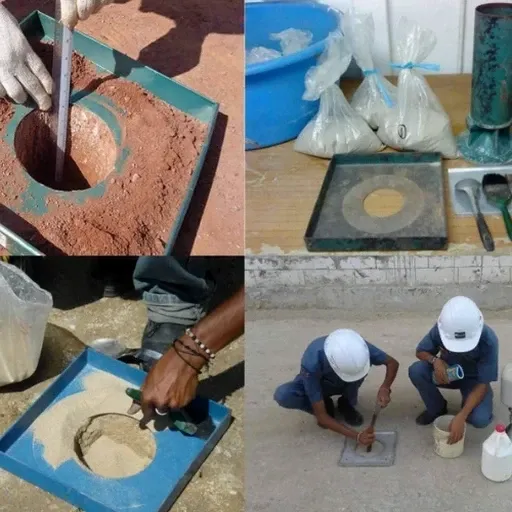
Adelaide's geological setting presents unique challenges that demand rigorous site investigation. The city stretches from the Gulf St Vincent across the Quaternary alluvium of the Adelaide Plains, rising into the foothills of the Mount Lofty Ranges underlain by Proterozoic and Cambrian metasediments. Much of the metropolitan area is infamous for its highly reactive Keswick and Urrbrae clays, which undergo significant volume change with seasonal moisture variation. In these conditions, a simple field density test (sand cone method) becomes essential to verify compaction and understand the soil's current state, while strength and stiffness testing is vital to predict slab performance on expansive subgrades.
Adherence to Australian Standards is non-negotiable in all in-situ investigations. Testing procedures are governed primarily by the AS 1289 series for soil testing methods, with specific parts dictating the execution of field density tests (AS 1289.5.3.1), bearing capacity assessments, and permeability measurements. Structural design actions are framed by AS 1170, while earthwork specifications typically reference AS 3798. For projects involving deeper rock strata, the field permeability test (Lefranc/Lugeon) is conducted following guidelines aligned with international standards like Houlsby for Lugeon testing, ensuring water inflow estimates are accurate for basement excavations, dam foundations, or grouting design in fractured Adelaide Hills rock.
The application of in-situ testing spans the full spectrum of construction in South Australia. Residential developments on the northern and southern fringes routinely require plate load testing to validate the bearing capacity of compacted fill pads prior to slab construction. Large-scale infrastructure, such as the North-South Corridor upgrades, demands comprehensive plate load test (PLT) programs to confirm modulus of subgrade reaction for pavement design. Meanwhile, commercial high-rises and deep excavations in the CBD lean heavily on permeability testing to dewater effectively, and density testing to certify backfill around retaining structures, ensuring long-term stability in a variable ground profile.
In-situ tests measure soil properties under natural stress, moisture, and structural conditions, which is critical in Adelaide's reactive clay zones where sample disturbance can alter strength and volume change behaviour. Field tests like the plate load test capture the true mass stiffness and drainage conditions that govern foundation settlement, providing a direct performance assessment that laboratory tests on small, disturbed specimens cannot replicate.
A plate load test is specified when direct measurement of a soil's modulus of subgrade reaction or bearing capacity under a rigid footing is needed, such as for residential slabs on compacted fill or pavement design. Unlike the SPT, which provides an indirect N-value correlation, PLT directly simulates foundation loading, offering definitive verification for performance-based designs on Adelaide's variable alluvial and clayey subgrades.
Field density testing frequency is typically governed by project specifications referencing AS 3798, which provides minimum testing rates based on fill volume, lift thickness, and material variability. On South Australian projects, a common requirement is one test per 500m² per compacted layer, though more stringent frequencies are applied for structural fill zones or where reactive clays demand rigorous compaction control to mitigate future movement.
The Lefranc test is a variable-head or constant-head test used in unconsolidated soils and soft rock above the water table, measuring local hydraulic conductivity. The Lugeon test is specifically for fractured rock under pressure, quantifying water loss in Lugeon units to assess rock mass groutability. In Adelaide, Lefranc suits alluvial plain investigations, while Lugeon is essential for dam and tunnel projects in the fractured metamorphic rocks of the Mount Lofty Ranges.