Site investigations you can build on.
LEARN MOREGround improvement in Adelaide encompasses a suite of geotechnical engineering techniques designed to enhance the engineering properties of soil and rock masses. Given the city's variable subsurface conditions, these methods are not merely optional but often essential for the safe and economical construction of infrastructure. The category covers everything from densification and reinforcement to drainage and chemical stabilisation, all aimed at increasing bearing capacity, reducing settlement, and mitigating liquefaction potential. A thorough understanding of local ground behaviour is critical, as it directly informs the selection and design of the most appropriate technique, such as stone column design for soft cohesive soils or vibrocompaction design for loose granular deposits.
Adelaide's geology presents a unique challenge, dominated by the highly reactive Keswick and Hindmarsh Clays, interspersed with alluvial sands and silts along the River Torrens and coastal plains. These expansive clays undergo significant volume changes with moisture fluctuation, causing severe distress to lightly loaded structures, while the loose, water-saturated sands in some areas pose a risk of liquefaction during a seismic event. The presence of calcareous sands, or 'shelly' sands, particularly near the coast, adds another layer of complexity due to their crushable nature. This geological mosaic means a one-size-fits-all foundation approach is rarely feasible, making specialist ground improvement a prerequisite for long-term structural integrity.
The design and execution of ground improvement works in Australia are governed by a robust framework of national and local standards. The primary reference is AS 4678-2002 (Earth-retaining structures), which is complemented by AS 2159-2009 (Piling – Design and installation) and the overarching AS 5100 series for bridge design. For seismic considerations, AS 1170.4-2007 (Structural design actions – Earthquake actions in Australia) is paramount, especially when assessing liquefaction potential. Crucially, practitioners must adhere to local council development plans and any specific guidelines issued by the Department for Infrastructure and Transport (DIT) for public projects, which often mandate rigorous site investigation and performance verification testing for any ground treatment.
The types of projects requiring ground improvement in Adelaide are diverse, reflecting the city's ongoing growth and infrastructure renewal. Large-scale commercial and residential developments on the city fringe, where weak alluvial deposits are common, routinely rely on these techniques to support shallow footings instead of deep piled foundations. Critical transport infrastructure, such as the North-South Corridor upgrades, involves extensive ground treatment for bridge abutments and approach embankments to control differential settlement. Industrial facilities with heavy floor loadings and liquid storage tanks on the Le Fevre Peninsula also demand carefully designed solutions like stone columns to ensure serviceability. Furthermore, the redevelopment of brownfield sites often necessitates vibrocompaction to densify loose fill and mitigate future settlement risks.
The primary method for dealing with reactive clays in Adelaide is moisture control, often achieved through proper site drainage and the use of flexible pavement systems. For structural foundations, techniques like deep soil mixing or lime stabilisation can chemically modify the clay's expansive nature. Alternatively, stiffened raft slabs or bored piers are used to bypass the active zone, while physical methods like stone columns can reinforce the soil mass and provide a load transfer mechanism, though their design must account for potential lateral swelling pressures.
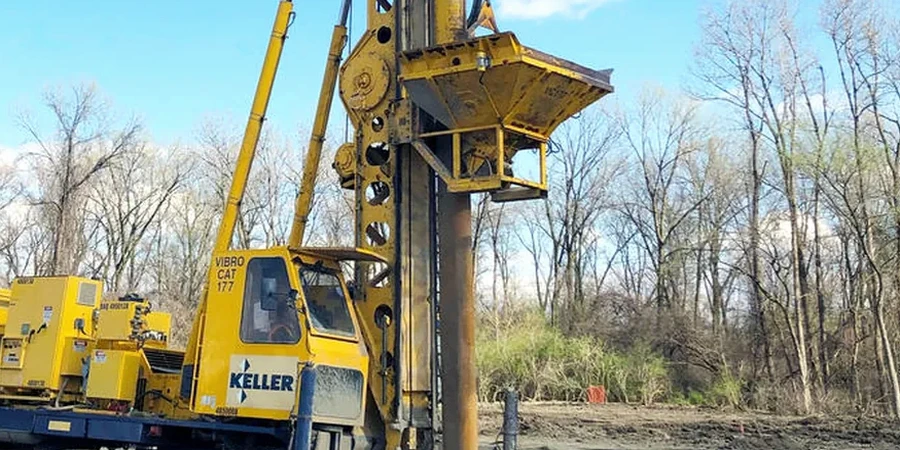
Ground improvement is often preferred over piling when the objective is to treat the entire soil mass, not just transfer loads to rock. For sites with deep, soft clays or loose sands, methods like vibro stone columns can densify and reinforce the ground, allowing for conventional shallow footings. This is typically more cost-effective for large building footprints and floor slabs, as it eliminates the need for structural slab systems and the complex load transfer from piles to the ground, resulting in faster construction and reduced concrete volumes.
Although Adelaide's seismicity is moderate, certain areas with loose, saturated sandy soils are susceptible to liquefaction. A site-specific seismic hazard assessment in accordance with AS 1170.4 is the first step. If the risk is unacceptable, ground improvement techniques like vibrocompaction are used to densify the sand, increasing its relative density and cyclic resistance. Stone columns can also be installed, functioning as both a densifying element and a vertical drain, allowing excess pore water pressure to dissipate rapidly during an earthquake, thereby preventing a loss of soil strength.
Post-treatment verification is a mandatory part of any ground improvement project to ensure the design criteria have been met. Common in-situ tests include Cone Penetration Tests (CPT) and Standard Penetration Tests (SPT) to check the increase in tip resistance and N-value in densified soils. Large-scale zone load tests or plate load tests are performed to verify the composite stiffness and bearing capacity of treated ground. For stone columns, individual column load tests may be required, and geophysical methods like cross-hole seismic testing can verify the overall mass stiffness improvement.