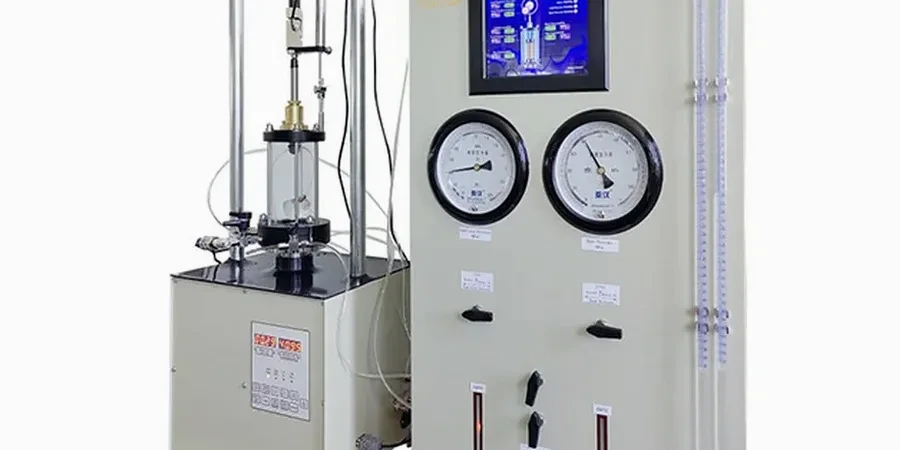
A recent 8-storey mixed-use project along Currie Street hit the typical Adelaide profile: stiff Hindmarsh Clay overlying the Hallett Cove Sandstone at about 12 metres. The geotechnical brief demanded effective stress parameters for a deep excavation assessment, so we ran a consolidated-undrained triaxial series with pore pressure measurement on Shelby tube samples recovered from the clay unit. Triaxial testing in Adelaide is not a one-size-fits-all exercise, because the transition from the Quaternary alluvium of the plains to the fractured rock of the Mount Lofty Ranges foothills can happen within a single site and each lithology needs its own stress path. Our NATA-accredited laboratory processes the specimens under back-pressure saturation following AS 1289.6.4.1, and we pair the Atterberg limits data with the triaxial campaign to confirm that the tested material is representative of the unit described in the borehole logs. For granular layers where undisturbed sampling is impractical, the shear strength envelope can be cross-checked against in-situ CPT test correlations, which gives the design team a second independent line of evidence.
Shear strength parameters from a properly saturated triaxial series can reduce piling costs by 15–20 percent compared with conservative empirical estimates.