Site investigations you can build on.
LEARN MOREUnderground excavations in Adelaide represent a sophisticated discipline of geotechnical engineering that encompasses the design, construction, and support of subterranean openings in complex ground conditions. From urban transport tunnels beneath the CBD to deep basements for commercial towers and essential service conduits, these projects demand a rigorous understanding of soil and rock behaviour under confined stress. The category covers the full lifecycle of an excavation: site characterisation, numerical modelling, temporary and permanent support design, groundwater control, and real-time performance verification. For a city like Adelaide, where infrastructure renewal is accelerating alongside sensitive heritage structures, the ability to execute precise underground works without causing unacceptable surface settlement is critical to maintaining urban resilience.
Adelaide’s geology presents a distinctive challenge for underground construction. The city straddles two contrasting domains: the Quaternary alluvial sediments of the Adelaide Plains and the older, highly reactive formations of the Willunga Basin and Eden-Burnside Fault Zone. Much of the metropolitan area is underlain by the Hallett Cove Sandstone, the Sturt Tillite, and the deeply weathered basement rocks of the Adelaide Geosyncline. These materials range from soft, water-sensitive silts and clays along the Torrens River corridor to variably cemented sands and extremely hard quartzite lenses. Crucially, the presence of the Keswick Clay and the Hindmarsh Clay, both notorious for their shrink-swell potential and low permeability, demands specialised approaches to excavation support and dewatering. In hillside suburbs, excavations may encounter colluvium overlying fractured phyllite, where rockfall and wedge instability become dominant hazards. Understanding this geological mosaic is fundamental to any underground project in the region.
The regulatory framework governing underground excavations in South Australia is anchored in national standards with local statutory force. Primary guidance is drawn from AS 4678-2002 for earth-retaining structures and AS 5100.3-2017 for bridge and culvert foundations, which often apply to cut-and-cover tunnels. For deeper works, AS 3785.1-2006 on underground mining and tunnelling safety provides critical risk management protocols. The Work Health and Safety Act 2012 (SA) and the associated Work Health and Safety Regulations 2012 (SA) impose strict duties on designers and constructors to eliminate or minimise geotechnical risks through the hierarchy of control. Additionally, the Planning, Development and Infrastructure Act 2016 (SA) requires that development applications for significant excavations demonstrate compliance with groundwater protection policies, particularly where dewatering may affect adjacent properties or contaminate aquifers. Adherence to these instruments is non-negotiable and forms the backbone of any legally defensible excavation methodology.
Projects across Adelaide that depend on this category are diverse and expanding. The ongoing renewal of the North-South Corridor has necessitated deep road cuttings and cut-and-cover structures requiring robust geotechnical analysis for soft soil tunnels, particularly where the alignment intersects the River Torrens floodplain. High-rise developments in the city core routinely call for geotechnical design of deep excavations to create multi-level basements within metres of neighbouring buildings and tram lines. Critical utility upgrades, such as the installation of deep trunk sewers or stormwater diversion tunnels beneath existing infrastructure, rely on continuous geotechnical excavation monitoring to validate design assumptions and trigger contingency measures. Whether for a microtunnel bore beneath a railway embankment or a large-diameter TBM drive through mixed-face conditions, the integration of analysis, design, and monitoring defines the success of Adelaide's underground engineering ventures.
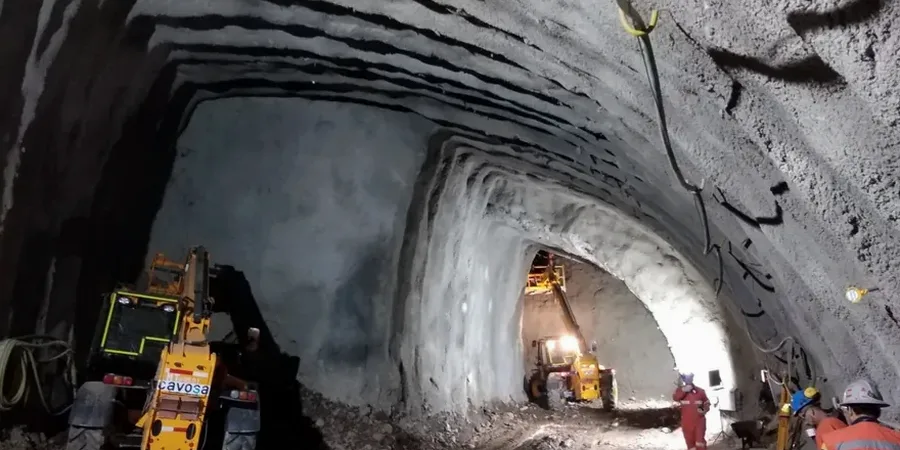
Methods vary with ground conditions and project constraints. In the soft alluvial clays of the plains, closed-face tunnelling techniques like earth pressure balance (EPB) machines are common to control face stability and settlement. In the competent rock of the foothills, drill-and-blast or roadheader excavation is typical for larger caverns. Cut-and-cover remains widely used for shallow metro stations and road underpasses, often employing secant pile or diaphragm walls as temporary or permanent support.
The Keswick Clay is a stiff, overconsolidated clay with significant shrink-swell potential and very low hydraulic conductivity. During excavation, unloading can cause gradual swelling and softening, leading to loss of passive resistance over time. Designers must account for this by specifying robust retaining systems like propped contiguous bored pile walls, limiting open excavation stand-up time, and implementing strict groundwater recharge measures to prevent desiccation of the clay behind the wall, which can induce settlement.
Essential parameters include three-dimensional ground surface settlement, subsurface lateral displacement via inclinometers, vibration levels from blasting or heavy machinery, pore water pressure changes, and structural convergence within the opening. In Adelaide's urban context, monitoring of heritage-listed buildings for tilt and crack propagation is mandatory. Automated total stations and real-time data loggers are typically linked to action trigger levels defined in the project's observation method plan, ensuring immediate response to any exceedance.
Waterproofing design is primarily governed by AS 4654.2-2012, which provides performance requirements for internal and external water barriers in below-ground structures. For tunnels, the relevant guideline is the Austroads Guide to Tunnelling, which references BS 8102:2009 as a benchmark for defining water tightness grades. In Adelaide's reactive clay soils, the standard also requires compatibility of the waterproofing membrane with potential ground movement, and all drainage systems must comply with the South Australian Public Health (Wastewater) Regulations 2013.